Let's be honest. The first time I tried writing conferences, it was chaos. And not the good kind of controlled chaos where the magic happens in the classroom!
This might be dating myself, but my students wrote on paper. Computers meant reserving the lab. No games, no AI... and it was STILL messy. A few kids were lost in their drafts. A few were debating what was for lunch. A few were folding paper airplanes.
Because writing is hard work. And when it's hard, middle schoolers will find something easier to do.
Who are we kidding? It still happens to me every single year.
If you've ever sat down with one seventh grader and felt the room go quiet in the wrong way, this one's for you.
Here's the short version, friend: before you can confer with one writer, the other 29 need routines that work without you. I teach six: a writing-time expectation, a revision checklist, a daily plan, help that isn't me, five quiet minutes, and a lap of the room between conferences. Practice them until the room runs on its own. Then confer.
Why do writing conferences fall apart in middle school?
The conference isn't the problem. The other 29 are. If the room needs me every ninety seconds, I can't give one writer five focused minutes.
Middle schoolers are still learning what independent work looks like. They finish a paragraph and wait. They get stuck and come find me. They don't know what to do, so they find something else to do (hello, paper airplanes).
That first year, I took a deep breath and stopped it all. Hear me out.
How do you reset a class that won't stay on task?
I asked everyone to turn to a fresh page in the writer's notebook section. Then I went to my overhead projector (yep, the overhead!) and started a list of everything I know something about. Ice cream. Brothers. Broken bones. Friends. Paper airplanes.
That's a Writing Territories list, and the idea comes from Kelly Gallagher. Students made their own in three minutes. Then each of them picked one thing and wrote. An informative piece, an argument, a technical booklet, a picture book. I didn't care what. They just needed to be writing.
And then I did the thing that changed everything. I didn't confer.
Why should you watch before you confer?
I sat at my conference spot like I was in a conference, roster in hand, and I watched. Who struggled to start? Who dove right in? Who suddenly needed the restroom? I made notes on my roster.
I did it in every class. Then I looked for patterns and did it again the next day with one small change. It took a few weeks! Small group conferences came next. One-on-one came last.
And every year, we start over. Every class is different, and every year brings new challenges. So if your room isn't ready in three days, nothing is wrong with you. That's the foundation the whole system sits on.
What should the rest of the class do during writing conferences?
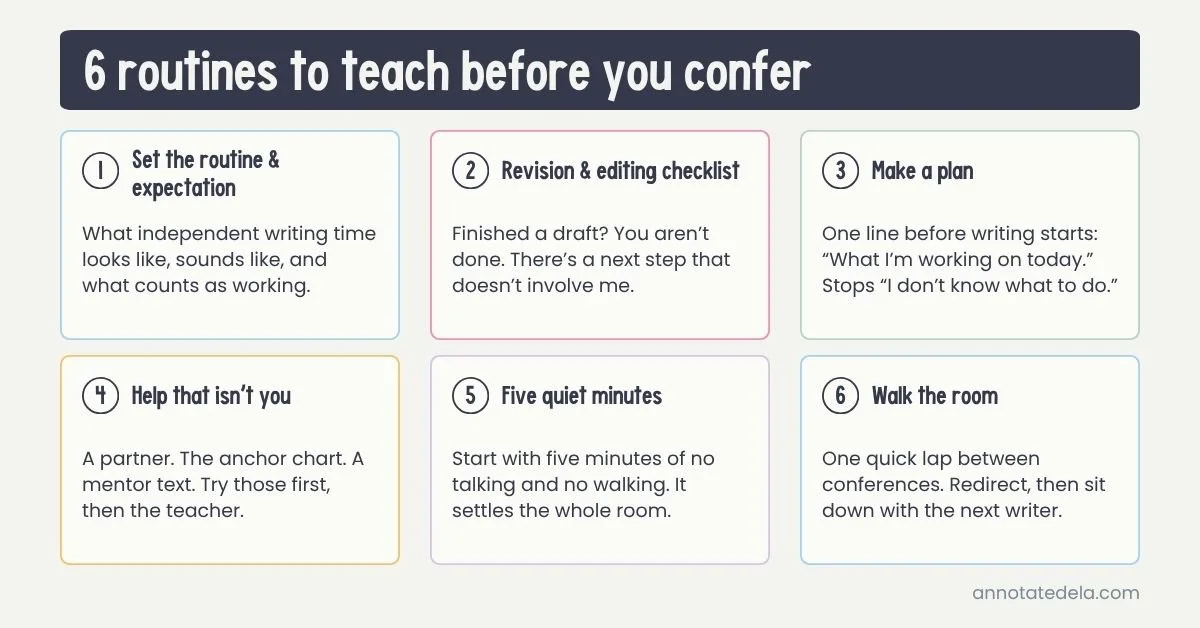
Here are the six routines I teach before my first conference. Practice them like any other procedure.
1. Set the expectation for independent writing time. What does it look like? What does it sound like? What counts as working? Put it on an anchor chart so you can point instead of repeat.
2. Give them a revision and editing checklist. "I'm done!" isn't a thing during writing time. If they finish a draft, they have a next step that doesn't involve me.
3. Have them make a plan. Before writing starts, each student writes one line: what I'm working on today. It takes a minute, and it stops "I don't know what to do."
4. Teach them where to go for help that isn't me. A partner. The anchor chart. A mentor text. They try those first, then me.
5. Start with five minutes of no talking and no walking. Hear me out on this one! It sounds small, and it settles the whole room.
6. Between conferences, walk the room. One quick lap. Redirect whoever needs it. Then sit back down with the next writer.
Please use what you and your students need and leave the rest!! If your class already has a strong writing-time routine, skip it. The humans in front of me guide my instruction, and the humans in front of you guide yours.
What does a five-minute writing conference look like with a middle schooler?
Once the room can go fifteen minutes without needing me, I sit down with one writer. Three steps: Listen, Reflect, Coach.
• Listen. "Which section do you want me to hear?" The student reads that part aloud.
• Reflect. I ask one open question, like "What is your main argument? Can you say it in one sentence?"
• Coach. I give one next step, and the student says it back to me.
How do I pick that one next step? I ask myself three questions. What is the goal? What skill does the writer need to reach the goal? What strategy will help the writer use the skill?
One conference, one focus. If I try to fix the claim, the evidence, AND the conclusion in five minutes, a seventh grader remembers none of it. If we work on the claim and only the claim, they walk away knowing exactly what to do.
I am teaching writers, not the writing. A conference isn't about fixing this one essay. It's about the writer knowing what to do next time, too.
How do you get to every student without losing track?
A rotation and a tracker. Let me show you the math, because it's kinder than you think. Three five-minute conferences a day is fifteen minutes of class. Three a day for ten school days is thirty students.
Bigger classes? Do four a day. Short periods? Do two and take three weeks. The number isn't the point. Having a list is the point.
Keep one line per conference: the student's name, the date, the focus, and the next step. At the end of the week, look down the focus column. If you wrote "evidence" eleven times, you don't have eleven problems. You have tomorrow's mini-lesson!
Your conferences just told you what to teach. Hello, one less thing on your teacher plate. Small wins turn into big wins.
Once your room is ready, here's a first conference week to try:
Day 1: Run writing time with the routines. No conferences. Walk the room.
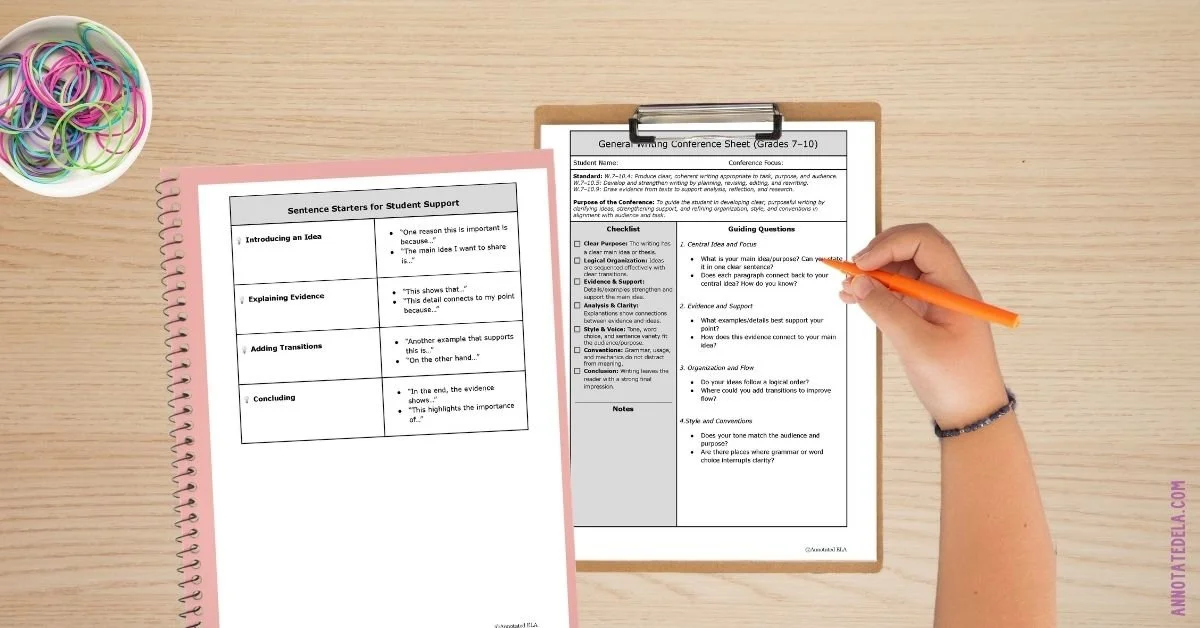
Day 2: Tell students conferences start tomorrow, and show them the conference sheet so nothing is a surprise.
Day 3: Your first two conferences. Pick students who'll be easy to talk to.
Day 4: Three conferences. Add a reflection starter at the end of class.
Day 5: Three more. Look down your focus column and pick next week's mini-lesson.
Want my conference flow and sheet for free?
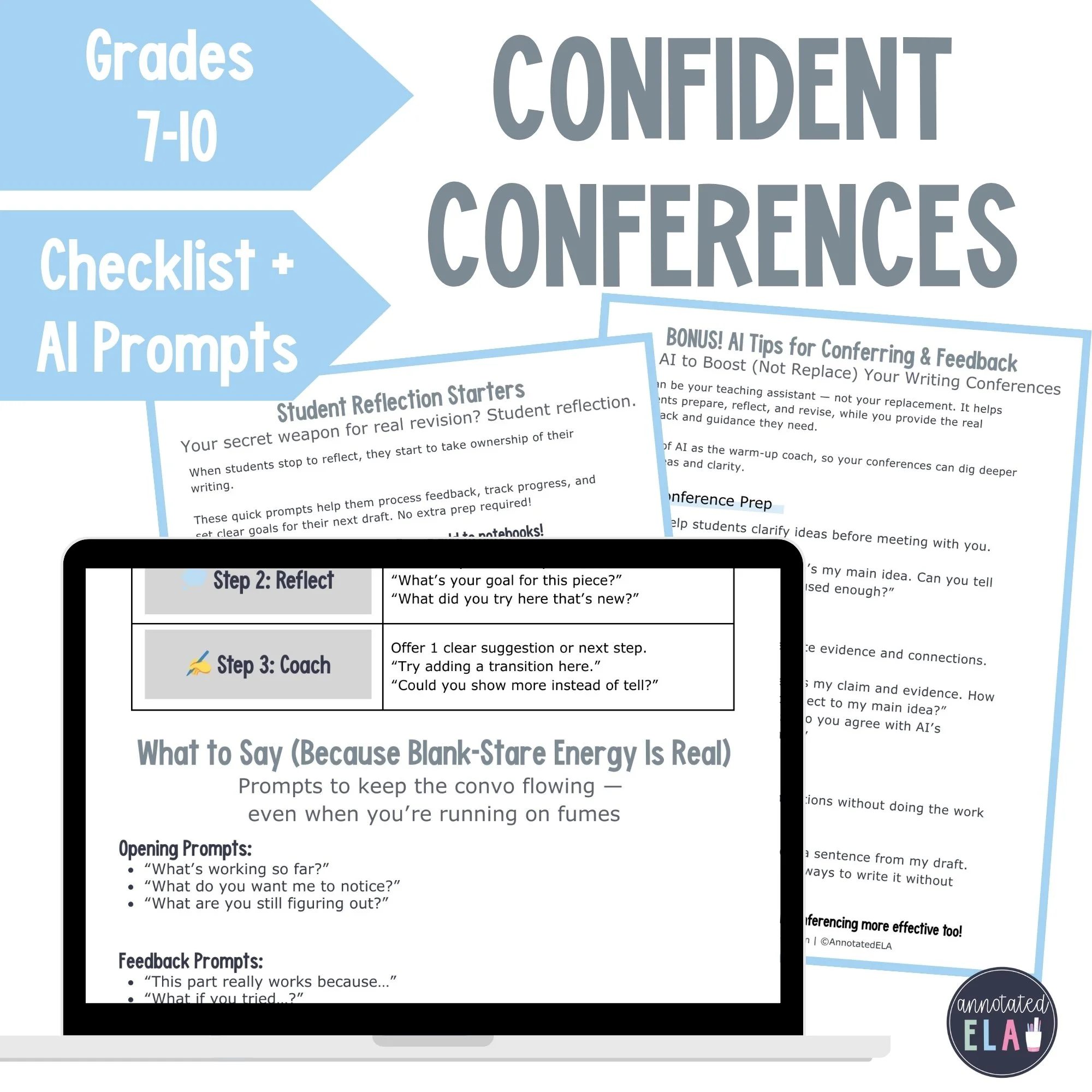
My free Confident Conferences guide walks you through Listen, Reflect, Coach and gives you a conference sheet with prompts for you and your students. Your very first conference will have a plan!
🔗 Grab the free Confident Conferences guide
Want the whole conference bundle?

Are your students struggling with clarity, organization, text evidence, research, and revision during writing workshop? This 8th Grade Writing Conference Bundle gives you a complete system of writing conference sheets aligned to W.8.1–W.8.9 so you can run focused, effective writing workshop conferences all year long.
If you’re tired of vague writing feedback and inconsistent conferencing notes, this standards aligned writing bundle provides structured, skill-specific writing conference forms that support formative assessment writing in middle school ELA. Each writing conference sheet is built to target a specific Common Core writing standard while keeping your conferences efficient, focused, and purposeful.
This is not a generic checklist. This is a writing workshop toolkit for middle school writing teachers who want clear structure, targeted feedback, and real student growth.
This writing workshop bundle includes individual writing conference sheets for:
✔ W.8.1 Argument Writing
✔ W.8.2 Informative / Explanatory Writing
✔ W.8.3 Narrative Writing
✔ W.8.4 Organization & Clarity
✔ W.8.5 Revision
✔ W.8.6 Technology & Publishing
✔ W.8.7 Research
✔ W.8.8 Source Evaluation & Citation
✔ W.8.9 Textual Evidence
Each writing conference sheet follows the same consistent structure so you can build predictable routines in your classroom.
Every resource includes:
✔ Clear Standard & Purpose
Each sheet clearly states the 8th grade writing standard and defines the purpose of the conference so students understand the focus.
✔ Writing Conference Checklist
Every writing conference form includes a standards-aligned checklist that allows you to quickly assess:
Claim and evidence development
Organization and coherence
Revision depth
Textual evidence integration
Research quality
Citation accuracy
Tone and clarity
This makes it ideal for formative assessment writing during writing workshop.
✔ Guiding Conference Questions
Each writing workshop conference sheet includes structured questions you can ask during one-on-one conferences, small group instruction, or intervention sessions.
✔ Scaffolds & Extensions
Support struggling writers and challenge advanced students with built-in scaffolds and extensions.
You’ll find:
Sentence frames
Graphic organizer suggestions
Strategy prompts
Extension challenges for deeper analysis
This makes the bundle ideal for differentiated writing conference tools in middle school.
✔ Small Group Adaptations
Need to run small group writing conferences instead of individual ones? Each sheet includes ready-to-use small group structures.
✔ Sentence Starters
Students receive academic language support tailored to the standard:
Introducing claims
Explaining evidence
Clarifying purpose
Integrating sources
Concluding effectively
✔ AI Writing Reflection Prompts
This is where your product stands out.
Each writing conference sheet includes AI writing reflection prompts that help students:
Evaluate feedback
Compare AI suggestions with their own thinking
Strengthen revision decisions
Practice responsible technology use
✔ Saves time during writing workshop
✔ Keeps conferences focused and standards-based
✔ Makes formative assessment writing organized and consistent
✔ Supports middle school writing intervention
✔ Helps students understand exactly what to fix and why
✔ Builds independence over time
✔ Works for whole group, small group, and 1:1 conferencing
Instead of scrambling to decide what to address during each conference, you’ll have a writing conference checklist aligned to the exact skill students need to improve.
Perfect For:
8th Grade Writing
Middle School ELA
Writing Workshop Model
Standards Aligned Writing Instruction
Essay Conferences
Argumentative Writing
Informational Writing
Narrative Writing
Research Projects
Textual Evidence Practice
Revision Lessons
Writing Intervention
Digital Writing Conferences
This 8th grade writing bundle is intentionally structured to cover the full writing progression:
(W.8.1) → Claim, Evidence, Counterclaim Informative
(W.8.2) → Explanation, Organization, Clarity Narrative
(W.8.3) → Structure, Development, Craft Organization
(W.8.4) → Coherence, Tone, Audience Revision
(W.8.5) → Strengthening Ideas & Structure Technology
(W.8.6) → Publishing & Digital Tools Research
(W.8.7) → Inquiry, Multiple Sources, Question Development Source Evaluation (W.8.8) → Credibility, Paraphrasing, MLA Text Evidence
(W.8.9) → Literary & Informational Analysis
This makes it a complete 8th-grade ELA writing resource system rather than a single checklist.
Formats Included
✔ Printable PDF Writing Conference Sheets
✔ Digital Access via Google Docs links
✔ Ready for Google Drive Upload
✔ Editable in your own Google account
This allows flexibility for:
Paper-based conferences
Digital writing workshop
Hybrid classrooms
1:1 Chromebook environments
Use this writing workshop bundle to:
▪ Run targeted writing conferences by standard
▪ Pull small intervention groups
▪ Track student progress across the year
▪ Collect formative assessment data
▪ Prepare students for state testing
▪ Support essay writing units
▪ Strengthen research and source evaluation skills
▪ Improve textual evidence integration
You can even use these sheets as documentation during data meetings or parent conferences.
Instead of purchasing individual writing conference sheets separately, this 8th grade writing bundle gives you a complete system aligned to W.8.1–W.8.9.
It supports:
Middle school writing curriculum planning
Writing workshop organization
Standards aligned writing checklist implementation
Long-term skill development
And because each product follows the same structure, your students learn exactly what to expect during conferences.
Consistency builds confidence.
Ready to Simplify Writing Workshop?
Grab this 8th Grade Writing Conference Bundle and bring clarity, focus, and structure to your writing workshop today.
Then add it to your cart and build a writing conference system that supports argument, informative, narrative, research, revision, and text evidence — all in one cohesive bundle.
Copyright © Annotated ELA, Melissa Burch
Permission to copy for single classroom use only.
Please purchase additional licenses if you intend to share this product.

Transform your writing conferences with this complete bundle of standards-aligned Writing Conference Sheets—one for every W.9–10 writing standard.
Each sheet provides structured, student-friendly support for focused revision and feedback across grades 9–10 ELA.
Each sheet includes clear checklists, guiding questions, sentence stems, and scaffolds designed to strengthen student writing—plus small group adaptations to support peer feedback or differentiated instruction.
Whether you're holding 1:1 conferences, peer editing sessions, or small-group workshops, these tools make writing instruction targeted, scaffolded, and standards-based.
✏️ Standards-Based Focus Sheets Included:
W.9–10.1: Argumentative Writing
Craft clear claims and counterclaims
Use reasoning and evidence persuasively
Strengthen logic, tone, and transitions
W.9–10.2: Informative/Explanatory Writing
Develop topics with relevant facts and definitions
Organize complex ideas clearly
Maintain formal tone and domain-specific vocabulary
W.9–10.3: Narrative Writing
Build engaging openings and well-paced plots
Strengthen reflection, character development, and descriptive detail
Reinforce voice and consistent point of view
W.9–10.4: Clear & Coherent Writing
Revise for tone, organization, and sentence flow
Match writing style to purpose and audience
Strengthen transitions and vocabulary precision
W.9–10.5: Planning, Revising, & Editing
Guide students through big-picture revision and grammar edits
Support rewriting with intention and structure
Encourage risk-taking and trying new approaches
W.9–10.7: Research Projects
Narrow or broaden inquiry questions
Synthesize from multiple sources
Stay focused on purposeful research outcomes
W.9–10.8: Integrating Sources & Avoiding Plagiarism
Find and evaluate authoritative sources
Paraphrase and cite effectively using MLA
Maintain a consistent voice while blending research
W.9–10.9: Using Textual Evidence
Select strong quotes or details from texts
Explain and analyze—not just restate
Connect evidence clearly to claims or insights
Perfect For:
1:1 or small-group ELA instruction
Supporting standards-based writing goals
Research paper units
Skill-based intervention or extension
Targeted writing interventions or enrichment
Small group station activities
Each Sheet Includes:
A student-facing checklist aligned to the standard
Open-ended prompts for conferencing or small groups
Sentence starters and scaffolds for struggling writers
Extension ideas for advanced learners
Mini-lesson suggestions and group activities
Formats in both PDF and Google Docs™
Key Features:
Aligned to W.9–10 Common Core Standards
Sentence starters and revision stems
Scaffolded questions and revision strategies
Feedback adaptations
Great for use all year with any writing genre
Bonus Value:
All sheets are available individually—save by grabbing this discounted bundle and have a conference tool ready for every standard!
With this complete bundle, you’ll support every secondary writer with the tools they need to meet the full range of W.9–10 writing standards—one focused, feedback-driven conference at a time.
Copyright © Annotated ELA, Melissa Burch
Permission to copy for single classroom use only.
Please purchase additional licenses if you intend to share this product.
Frequently asked questions
How long should a writing conference be in middle school? Aim for about five minutes. That's long enough to listen to one section, ask one question, and give one next step. Your first few will run longer, and that's normal. Within a week or two you'll find the rhythm, and five minutes lets you meet with three students in fifteen minutes of class.
What do students do while the teacher holds writing conferences? They write, revise, or get help from someone other than the teacher. Six routines make that possible: a clear expectation for writing time, a revision checklist, a one-line daily plan, a list of places to get help, five quiet minutes to start, and a quick lap of the room between conferences.
How often should I conference with each student? A two-week rotation works for most middle school classes. Three conferences a day for ten school days reaches thirty students. With bigger classes, do four a day. With short periods, do two a day and stretch the rotation to three weeks. Leave one open slot each day for whoever needs you most.
What should I focus on in a middle school writing conference? Pick one focus per conference. Ask what the goal is, what skill the writer needs to reach it, and what strategy will help. Work on that one skill and save the rest for next time. One clear next step is what a middle schooler can actually act on.
How do I keep track of writing conferences? Keep one line per conference with four things: the student's name, the date, the focus, and the next step. It takes about fifteen seconds. Next time, open with "Last time you were working on your claim. Show me what you did." Then look down the focus column each week to plan mini-lessons.
One step at a time, friend. Let's take the overwhelm and kick it to the curb!
Which routine does your class need first? Send me an email and tell me. I love hearing from you!
Here's to the magic of writing!
— Melissa, Annotated ELA